The Friday lunch that used to need a waitlist. The weekend brunch running at half covers. The group booking that cancelled with 48 hours' notice and left a gap you couldn't fill.
If that reads like your last two weeks, you're already doing the math on what a slower season means for the month ahead.
But here's the number that should actually be driving that calculation. Based on spending and visit frequency data across Servme-powered venues in the UAE, a loyal local guest is worth up to AED 10,000 in lifetime value.
That’s not a come-once-and-never-again tourist table. It’s a different, more consistent revenue category.
That figure is the result of what strong restaurant customer retention looks like in practice. Converting first-time guests into repeat visitors through personalized service, consistent recognition, and data-driven outreach.
For UAE and GCC operators, it's not a nice-to-have. It's the difference between a revenue base that holds through a slow season and one that doesn't.
UAE residents dine out an average of 2.5 times per week, while 52% dine out 3 times per week, a frequency that compounds into significant annual revenue per guest.
They bring colleagues, book birthdays, and recommend you to their community’s WhatsApp group.
The revenue exists. But are you capturing it?
In this guide, we'll cover what local dining loyalty actually looks like, how to identify your resident guests, and 6 strategies UAE restaurant operators can start acting on this week.
What Does Local Dining Loyalty Actually Look Like?
Most restaurants understand loyalty in theory. However, few know how to build it. The gap usually comes down to guests wanting to feel known, not processed.
Delivering on that consistently, across every shift and host is harder than it sounds.
Personalized dining experiences are rarely the result of memory.
Here's what genuine loyalty, from residents, looks like in your concept:
The guest who books for 2 every other Thursday, without fail, for 8 months. That's 16 covers before they've even brought a friend.
The resident who booked your private dining room for their birthday, then came back for a colleague's farewell. They’ve introduced you to an average of 8–12 new covers each time.
The Ramadan regular who books iftar with family every year and has referred you to 3 other households over time.
The corporate contact who started with a team lunch and now runs every client dinner through your venue. That’s more monthly revenue than a week of tourist footfall.
The guest who mentions your name in their building's WhatsApp group after one great experience, bringing you exposure and covers from people who've never heard of you.
Every guest in that list started as a first visit. Servme's CRM tracks the history, preferences, and booking patterns that turn a first-timer into a Thursday regular.
Further reading: The Complete Playbook for Restaurant Customer Loyalty: Turning First-Timers to Regulars
Do You Know Your Guest Mix?
Most operators have a rough intuition about their tourist-to-resident ratio, but few know how to measure it or act on it.
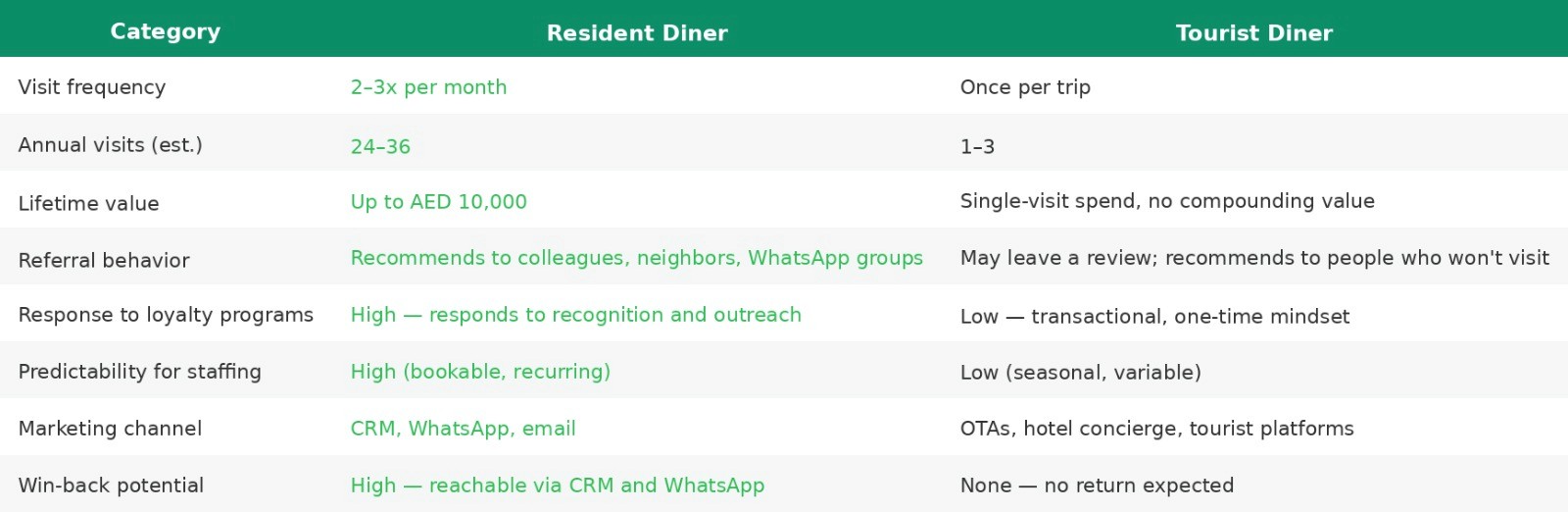
Your booking data, reservation sources, and repeat visit frequency tell you exactly who is coming back and who isn't. A tourist visits once. A resident can visit 2–3 times a month.
The lifetime value gap between these two guest types is significant. During a tourist downturn, operators still leaning on tourist-facing positioning are marketing to people who aren't there.
Practical prompt: Pull your last 90 days of booking data on your restaurant reservation system.
What percentage of covers were first-time visitors versus returning guests?
That number is your starting point. Use Servme’s reservation and table management software to filter by visit frequency and identify which guests have returned more than once during the 3-month period. Those are your residents. They're the segment worth doubling down on right now.
Not sure what your resident-to-tourist ratio looks like? Use Servme's CRM to pull your booking history and visit frequency into a single dashboard and see who’s driving your covers, and who isn't coming back. Book a free consultation and we'll walk you through your own data.
Why Are Local Diners a More Reliable Revenue Base?
Tourist traffic isn't a reliable business model. Tourists are transient. Meanwhile, residents are the foundation. They are there year-round.
Here are 3 reasons why retaining locals a strategy that outperforms tourists as a long-term revenue base:
Frequency: Residents in the UAE dine out an average of 2x per week. A tourist visits once per trip. Sometimes once in a lifetime. That difference, compounded across a year, is the gap between a thriving regular base and a restaurant that restarts from zero every season.
Loyalty program responsiveness: Residents are much more likely to respond to loyalty initiatives and referral programs as they become frequent users.
Word-of-mouth that converts: A tourist recommends you to people who may never visit. A resident, on the other hand, recommends you to their colleagues, neighbors, family, friends, community WhatsApp groups,…etc. They bring your name up in conversations with people who live in the vicinity and are looking for what you’re offering.
The shift from tourist-dependent to resident-first isn't meant to be a marketing adjustment. It should be a critical part of your restaurant marketing strategy. It’s a more stable, measurable, and profitable business model.
Further reading: See How Hyatt Regency Dubai Venues Boost Retention with 88,000 Guest Profiles Using Servme
How to Shift Your Marketing Toward UAE Residents
We’ve divided this section into tiers based on how easy it is to implement these tips.
The aim is to use these tactics quickly to attract local diners and increase customer retention in your restaurant. A simple 5% increase in loyal guests can boost profits by 25% to 95%.
Tier 1: Tactics to do this week
1. Audit and update your Google Business Profile
Most residents don't discover restaurants through travel guides or hotel concierges. They open apps like Google Search, Google Maps, and Instagram. They search by area, cuisine, and opening hours.
Your restaurant’s Google Business Profile is often the first thing they see. Most restaurant profiles are months out of date with wrong hours, no recent photos, unanswered reviews.
This is the fastest local visibility win available. And it costs nothing.
Set aside two hours this week. Update your hours, upload recent photos of your concept and menu, and respond to your last 10 Google reviews, both positive and negative.
That activity signals to Google that your listing is active, which directly improves how you appear in local search results.
The operators who show up first in "best brunch [neighborhood/city]" aren't always the best restaurant. They're often just the most up-to-date listing.
Further reading: Reserve with Google for Restaurants: What Is It & How It Works
2. Reactivate your dormant local guest list
If you’ve got guest data, then you should launch a re-engagement restaurant email or WhatsApp campaign. And you don't need a discount to do it.
A simple three-message sequence over two weeks is enough. Use Servme’s template library, WhatsApp marketing templates, or generate a series of messages with this list of ChatGPT restaurant prompts.
Your re-engagement message should reference their last visit, mention a high-value offer like a new menu, seasonal event, or even their favorite dish, along with a reservation priority window.
See how Servme’s reservation, CRM, and marketing software come together to facilitate creating campaigns that drive results. Get in touch to see how it works!
3. Own the cultural calendar
Resident-driven dining moments include special occasions like Ramadan, Eid, Saudi or UAE National Day, Dubai Food Festival, summer staycation season, among others.
Identify these events and others, like Grilled Cheese Day (12 April) or International Burger Day (28 May), in your restaurant marketing calendar. It’s best to plan for these occasions in advance.
Data backs this up. Ramadan alone drives a 30% increase in hotel buffet bookings and a 15% spike in F&B sales. This demand comes to restaurants that communicate and market early and are easy to book.
Pick the next two cultural moments on the calendar. Build a simple offering around each one. Get it in front of your guest list before your competitors do.
Tier 2: To-do this month
4. Use social media for local discovery
Most restaurants are using social media for awareness and engagement. Few are using it to drive local discovery and increase online reservations.
Shift your content strategy toward neighborhood-level visibility. This includes adding location tags in every post, area-specific hashtags, sharing into local community groups, and prompting satisfied guests to leave a Google review before they leave the table.
Residents discover restaurants in a different way, compared to tourists. They search with nearby restaurants and cuisines. Not by landmark proximity. Your content should reflect that.
Further reading: Instagram for Restaurants: Best Practices & ROI Guide (2026)
5. Target corporate and B2B dining
Identify 2-3 office clusters, free zones, or residential compounds within a reasonable radius of your venue.
Using direct outreach, like a simple WhatsApp message to an operations manager or office administrator, can generate consistent weekday covers that are otherwise sitting with your competitors.
Corporate dining has a higher average spend and lower acquisition cost than walk-in tourist traffic. One good team lunch makes you the default venue for every client dinner that follows.
Tier 3: Long-term customer retention strategies for UAE restaurants
6. Introduce a resident recognition program
Not a discount program. A recognition program. The distinction matters.
Discounts train guests to wait for a deal. Recognition trains them to feel like they belong.
In practice, this looks like a tiered approach: Regulars get priority booking, frequent guests receive a personalized touch on arrival, top spenders get early access to new menus or exclusive events.
See how Servme’s auto-tagging and guest segmentation features help you recognize regulars, VIPs, and special-occasion lovers, improving your marketing campaigns.
In the UAE, 2 popular government initiatives are: Fazaa and Esaad. Both programs have large, active resident memberships, cardholders who are already looking for places to spend.
Fazaa, launched under the Ministry of Interior's Social Security Fund, has a network spanning over 34,000 outlets across the UAE. While Esaad is a Dubai Police initiative covering restaurants, hotels, retail, and more.
Listing your venue as a partner merchant on either platform isn't a loyalty strategy but a meaningful distribution channel that puts your dining concept before an audience of local, regular diners.
What Is a Good Restaurant Customer Retention Rate?
Before tracking numbers, you need to know what you're benchmarking against.
Industry data suggests 65%-80% of restaurant sales come from regulars and loyal customers.
But the reality is starker: 78.8% of restaurant guests churn annually, only 25% of first-time visitors return within 90 days. Meanwhile, 69% never go beyond a single visit, representing $375,380 in lost revenue opportunity per location, per year.
The gap between average operators and data-driven ones is significant.
Restaurants using integrated CRM and marketing automation report first-visit return rates of 35–45% and up to 30% of their guest base achieving regular status, compared to 12% for operators running fragmented systems.
Across Servme-powered venues in the UAE, restaurants using CRM-driven outreach and guest recognition see repeat guest rates of 50–60% within a 90-day window.
That gap, between the industry average and what a functioning retention system delivers, is measurable, closeable, and worth prioritizing above almost any other marketing investment.
How to Know If Your Local Retention Strategy Is Working
Strong restaurant customer retention doesn't show up in your revenue overnight. It takes weeks to appear in your data.
Use these 3 metrics to measure retention in your restaurant or chain.
Repeat visit rate
Are the same guests coming back within 30–60 days? This metric is the strongest indicator you’re building local loyalty and guests keep coming back.
Track it by comparing returning guest bookings against total covers each month. A rising repeat visit rate means your retention efforts are converting. A flat or declining one means your guest experience isn't giving guests a reason to return.
Further reading: Boost Your Profits with These 21 Restaurant Metrics [Guide]
Resident-to-tourist booking ratio
If your reservation system captures guest origin data, track how this ratio shifts over 60–90 days.
The trend matters more than the number. A slow, steady shift toward resident bookings is exactly what a local strategy should produce.
Win-back campaign response rate
Make sure you use locals’ preferred method of communication. Then create re-engagement and win-back campaigns.
Open rates above 60% and a re-engagement conversion rate above 10% indicate your messaging is landing with the right guests at the right time. Below those benchmarks, adjust the offer, the timing, or both before scaling the campaign.
One qualitative signal worth paying attention to alongside these metrics is figuring out where guests are coming from.
Did they hear about you from a friend, colleague or community group? Did they subscribe to your restaurant newsletter a while back? Did they find you via a local booking channel like Tripadvisor or Zomato in the UAE, or The Chefz and webook in Saudi Arabia? Or was it via a restaurant review platform?
Answering the ‘where’ question will give you an idea about marketing channels to consider.
The shift in referral source is one of the most reliable early indicators that your restaurant customer retention strategy is working.
Word-of-mouth from residents travels differently compared to a TripAdvisor review. It's warmer, more trusted, and more likely to convert.
Track repeat visit rate, booking sources, and more directly from your Servme dashboard. See it in action for your venue!
Start Attracting Locals & Building Retention Now
Use the slow season to build genuine relationships with local communities and guests. When tourists return, your concept will still be there, ready to welcome them back.
Your local resident base isn’t limited to a slow season. They are there year-round, showing up regularly. Locals fill the Tuesday lunch that used to depend on hotel overflow. They book the private dining room before you've had to promote it.
You can easily incentivize them to recommend you to others and they’ll gladly do it.
That's what restaurant customer retention looks like. It’s guests who have decided that your venue is their favorite venue.
Servme is built to help you get there. The CRM to know your guests, the tools to reach them, and the data to know it's working. If you're ready to start building a local strategy that drives revenue and growth, then find out how Servme helps.
Get in touch for a free consultation or personalized demo from our experts.
Frequently Asked Questions about Restaurant Customer Retention
Q: What is restaurant customer retention?
A: Restaurant customer retention is the ability to convert first-time diners into repeat visitors. It's measured by repeat visit rate, the percentage of guests who return within 30–60 days.
In UAE restaurants, resident diners are the primary retention target because they visit 2–3x per month versus a tourist's single visit.
Q: What is a good customer retention rate for a restaurant?
A: Most restaurants retain 30–40% of first-time guests for a second visit. High-performing UAE and GCC restaurants using CRM-driven outreach and personalized marketing typically achieve 50–60% repeat rates within 90 days. Tracking month-over-month repeat visit rate is the most reliable way to measure retention performance.
Q: What are the best customer retention strategies for restaurants?
A: The most effective restaurant customer retention strategies for UAE operators are: (1) reactivating dormant guests via WhatsApp or email campaigns, (2) owning the cultural calendar (Ramadan, Eid, UAE National Day), (3) targeting corporate and B2B dining, (4) introducing a resident recognition program, and (5) tracking repeat visit rate monthly to measure what's working.
Q: How do UAE restaurants attract local diners instead of relying on tourists?
A: UAE restaurants attract local diners by shifting from tourist-facing positioning to resident-first marketing. This includes updating Google Business Profiles for local search visibility, running re-engagement campaigns for dormant guests, building neighborhood-level social media presence, and listing on resident loyalty programs like Fazaa and Esaad.
Q: How is restaurant guest retention different from general customer retention?
A: Restaurant guest retention focuses on the dining relationship, repeat bookings, occasion recognition, and personalized service. Unlike general CRM, it relies on reservation data (visit frequency, party size, special occasions) to identify high-value regulars and activate them through it.
Nada Sobhi
Marketing
Tips and Insights to help you run a better business

Restaurant growth insights, delivered monthly
Join 4,000+ restaurant operators receiving marketing tips, guest experience best practices, and product updates in their inbox.